
If you’ve been in manufacturing long enough, you’ve watched the pendulum swing: “Everyone needs a four-year degree” … then “Actually, no one can find a job with that degree” … and now we’re landing on: “Wait, you mean I can earn good money, learn a real skill, and not get replaced by an algorithm?”
According to a new survey highlighted by HR Dive/Facilities Dive, 60% of Gen Z says they plan to pursue skilled trade work this year—including roles tied directly to manufacturing and industrial maintenance. The survey points to practical motivations: job security, good pay potential, and skill fit—plus a growing belief that trades are harder for AI to automate.
That last part matters. Gen Z has watched office jobs get “restructured” into oblivion and they’re not exactly feeling sentimental about corporate ladder culture. (Yes, the ladder is still there. It’s just leaning against a wall labeled “budget cuts.”) The trades feel concrete, real, and—crucially—needed.
But the story is messy: Gen Z is interested… and also not convinced
Here’s the twist: a separate Harris Poll report from last year painted a cooler picture, with fewer than 40% of Gen Z saying skilled trades offer the best job opportunities, and only 36% strongly agreeing trades are a faster, more affordable path to a good career.
So what changed? Two things can be true at the same time:
Gen Z is warming up to the trades, and
They still don’t fully understand the pathways, pay progression, and long-term upside.
That’s not a “kids these days” problem. That’s a branding + access + onboarding problem—and it’s fixable.
Demand is real, and it’s not slowing down
If you’re a manufacturing employer, you already know this: the skills gap isn’t a future concern—it’s your Tuesday.
The U.S. Bureau of Labor Statistics projects about 81,000 openings for electricians each year on average over the decade. Construction and infrastructure needs are also enormous, with hundreds of thousands of openings projected annually across construction and extraction occupations. And the AI boom is ironically adding fuel: data centers and energy projects are increasing demand for electricians, HVAC, and other critical trades.
Meaning: the same “AI revolution” that worries Gen Z about office jobs is also creating more work that requires hands-on technical talent. Poetic, honestly.
What Gen Z needs from manufacturing employers (in plain English)
If you want Gen Z to choose your plant, your facility, your team—don’t just post a job and hope for vibes.
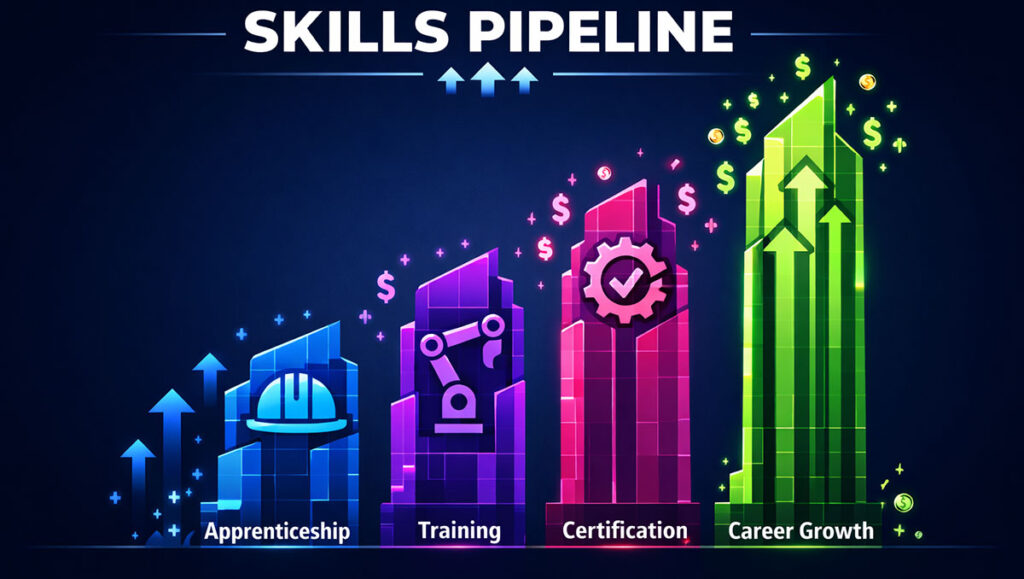
1) Make the path obvious.
Spell out what year 1 looks like, what year 3 looks like, and what “good” looks like in year 5. Promotions, pay steps, certifications, training—show it.
2) Pay like you mean it (and explain the total package).
Competitive wages matter, but so does predictable scheduling, overtime transparency, and benefits that don’t require a decoder ring.
3) Train like it’s strategy, not charity.
Apprenticeships, internal academies, partner programs—these aren’t “nice extras.” They’re the pipeline. Employers across industries are investing heavily in training and apprenticeships for exactly this reason.
4) Respect the human.
Gen Z will work hard. They will also leave fast if they’re treated like a disposable part. Safety culture, leadership behavior, and day-to-day dignity are retention tools.
Where WSI fits
At WSI , we work with large-scale manufacturing employers regionally and nationally to build reliable hiring pipelines—especially when you’re scaling, expanding shifts, or refilling critical roles. The Gen Z trade shift is a massive opportunity, but only if your recruiting message matches the reality of the job.
Because if Gen Z shows up and discovers the “career pathway” was just a poster in the breakroom… they’re gone.