Workforce Risk
Michigan has recorded 21 workplace fatalities this year. For employers running flexible labor, the safety program and the vetting program are no longer separate conversations.
July 28, 2026
MIOSHA issued a warning this week that reads less like a regulatory bulletin and more like a plea. Twenty one Michigan workers have died on the job so far in 2026. Three unrelated trench collapses in Southeast Michigan occurred inside a two day window, one of them fatal on July 1. Unrelated is the detail worth sitting with. Three separate employers, three separate job sites, three separate crews, and the same failure mode inside forty eight hours. The agency's message was blunt: conditions change, and hazard recognition has to change with them.
Michigan workplace fatalities reported to MIOSHA year to date in 2026.
Most plant leaders read that number and think about their own floor. The better question is broader. Who is standing on your floor today who was not there last week, and how much do you actually know about them?
Conditions Change Faster Than the Job Plan
MIOSHA Director Bart Pickelman framed the problem precisely.
Employers must make hazard recognition part of every job, provide workers with the training and protections they need and create a culture where employees are empowered to speak up and stop work when something is unsafe.
Bart Pickelman, MIOSHA Director
The operative word is every. Weather shifts. Equipment gets swapped. A supplier substitutes a material. Traffic patterns move. Second shift runs light and tasks get reassigned to someone who has never performed them. Each of those variables quietly invalidates the hazard assessment that was accurate on Monday.
Staffing volatility is the variable most often left off that list. A workforce that flexes weekly is a hazard profile that changes weekly. That is not an argument against flexible labor. It is an argument against treating flexible labor as interchangeable inventory.
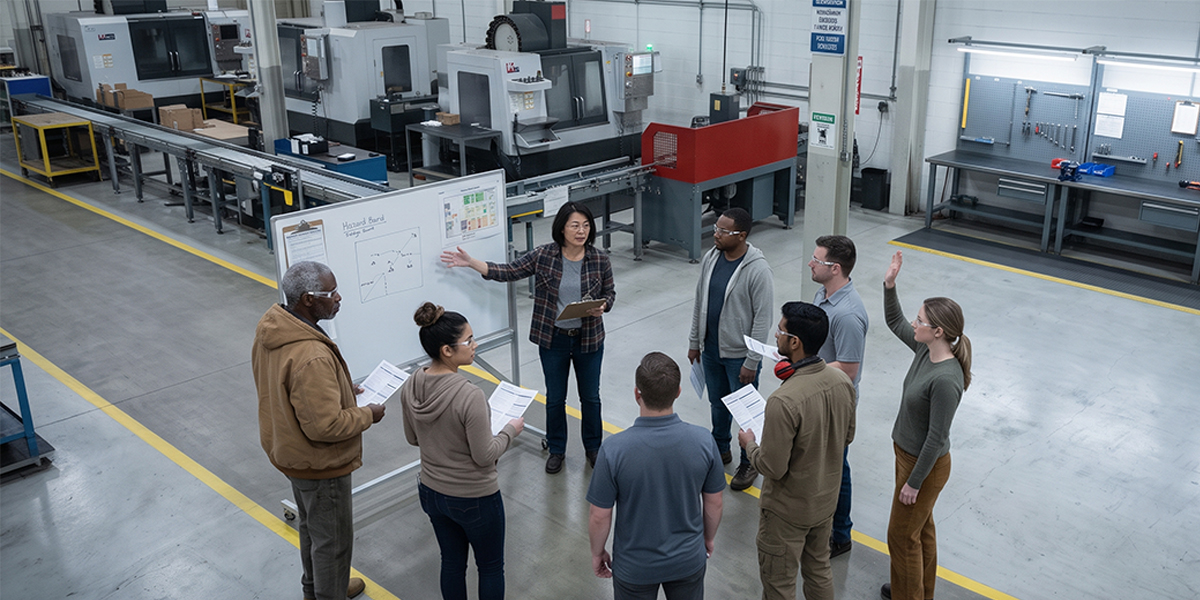
The Second Risk Nobody Puts on the Whiteboard
There is a version of workforce risk that never appears in a MIOSHA release, and it costs Michigan employers real money every year: workforce fraud.
It shows up in familiar patterns. Identity substitution, where the person who interviewed is not the person who reports to the line. Falsified credentials and forklift certifications that do not exist. Undisclosed work restrictions. And the expensive one, the pre existing injury that arrives on site and becomes a compensable claim within the first two weeks.
Here is the connection employers underestimate. A rigorous safety program is also the strongest fraud defense you will ever build. Documented, timestamped site orientation. Task specific training records tied to a verified identity. Signed hazard acknowledgments. Incident reporting with a same day trail. Every one of those controls exists to protect a worker, and every one of them also makes a fabricated claim nearly impossible to sustain.
Employers who cannot produce those records are not merely exposed to a MIOSHA citation. They are exposed to anyone who understands that undocumented workplaces do not defend themselves well.
What Premium Vetting Actually Buys
Commodity staffing competes on speed and fill rate. The math looks attractive until a single fraudulent claim or a single preventable injury clears the entire year of savings.
Rigorous placement operates differently:
- Verified identity and eligibility before a badge is issued, not after a claim is filed.
- Credential validation that confirms certifications independently rather than accepting a photocopy.
- Documented safety orientation matched to the actual task, not a generic slideshow.
- Placement fit that accounts for physical demands and experience, because mismatched placement is a leading upstream cause of injury.
- Continuity of record that survives turnover, so the paper trail does not vanish when the assignment ends.
This is the difference between renting headcount and managing a workforce. WSI treats entry level manufacturing talent as a premium product for exactly this reason. Vetting is not administrative overhead. It is loss prevention that happens to also be a hiring function.
The Resources Are Free. The Inaction Is Not.
MIOSHA's Consultation Education and Training Division offers free, confidential on site consultation with no enforcement trigger attached. Employers do not have to wait for an inspection or an incident. The agency's Stay Alert For Everyone initiative reinforces the same principle: situational awareness, and permission to stop work.
MIOSHA Employer Resources
- Free CET consultation and training: Michigan.gov/CET
- File a safety or health complaint: Michigan.gov/MIOSHAComplaint
- Learn about the SAFE initiative: Michigan.gov/StayAlert
- Preliminary fatality summaries: Michigan.gov/MIOSHAFatalities
Twenty one families in Michigan will not get a revised hazard assessment. The employers still operating have the one advantage those workers did not: time to reassess before conditions change again.
Your Workforce Risk Starts at the Vetting Stage
WSI places entry level manufacturing talent across Kalamazoo, Grand Rapids, Battle Creek, Sturgis and Holland with the documentation, credentialing and safety orientation standards that hold up under scrutiny.
Talk to WSI