
Workforce Economics
That is a real wage on Michigan production floors. The 2026 ALICE report says a family of four needs $36.80. Play the week below and find where it breaks.
July 28, 2026
Two wages, one household
$15.50 an hour is an ordinary wage on a Michigan production floor. It clears roughly $589 a week after withholding. $36.80 an hour is what a family of four actually requires, according to the 2026 update of the State of ALICE report. The ALICE Household Survival Budget for two adults, an infant, and a preschooler in Michigan runs $78,216 a year, or $6,518 a month. The distance between those two hourly figures is the entire argument. If you would rather test it than read about it, jump to the interactive week.
| Monthly expense | Cost |
|---|---|
| Child care | $1,338 |
| Housing | $1,340 |
| Food | $1,050 |
| Transportation | $825 |
| Health care | $725 |
| Taxes | $577 |
| Miscellaneous | $540 |
| Technology (phone and internet) | $121 |
| Monthly total | $6,516 |
The budget contains no savings, no debt service, and no line for a failed transmission. It is a survival figure, not a comfort figure.
Forty percent, and nearly all of them employed
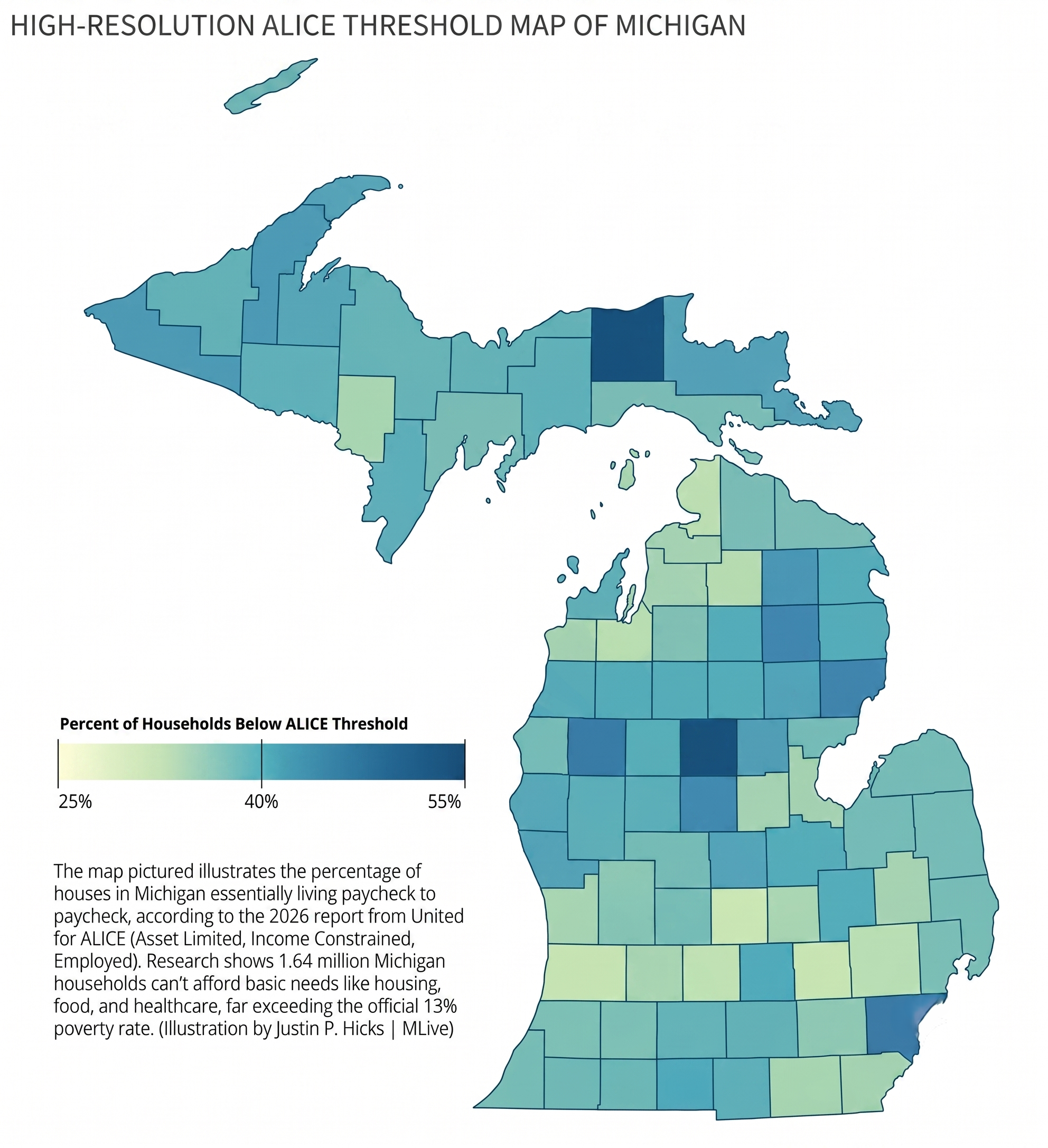
ALICE stands for Asset Limited, Income Constrained, Employed: households earning above the Federal Poverty Level but below the real cost of basics. In 2024, 26% of Michigan households were ALICE and 13% were in poverty, putting 40% below the threshold. The national figure was 41%, with a 29% and 13% split. Michigan ranked 29th among the states and the District of Columbia for financial hardship.
36%
Share of Michigan full-time workers who did not earn enough to cover the ALICE survival budget for one adult and one child. The national rate was 44%.
Full-time status is not the protection employers assume it is. Among Michigan cashiers, 47% fell below the threshold; among janitors, 43%. Those figures track national hardship rates of 49% and 45% for the same occupations. Meanwhile the ALICE Essentials Index, which measures the specific goods these households buy, grew 4.9% annually in Michigan from 2021 to 2024, outpacing general inflation. Nationally it grew 5.6%.
Housing carries much of the pressure. Seventy percent of Michigan renter households below the threshold were rent-burdened, paying 30% or more of income on housing, almost identical to the 71% national rate. The disparities run deeper in certain households: 62% of Black households, 73% of single-female-headed families, and 48% of households headed by someone 65 or older fell below the ALICE line.
Child care is the line item that sets your labor supply
At $1,338 a month, child care is the single largest expense in that budget, and it operates as a hiring constraint rather than a household inconvenience. On August 4, Kalamazoo County voters decide a 0.5 mill proposal that would raise roughly $6.4 million in its first year over an eight-year term, at a cost of about $50 annually on a $200,000 home.
What the proposal would fund
The measure targets four areas: subsidizing care for families earning above 200% of the Federal Poverty Level who often fall outside assistance programs, raising provider wages, funding programs directly, and building a system to help families locate available care. County commissioners split on whether a millage is the correct instrument, with some arguing the county should fund the priority from its existing budget. The underlying labor math is not in dispute: when care is unavailable or unaffordable, shifts go unfilled and second earners stay home.
Where the ground is firming
The trend line is not uniformly grim. Michigan was one of 22 states that saw a reduction in households below the ALICE threshold between 2021 and 2024, even as the national count kept climbing. The state minimum wage rose to $13.73 in January 2026 and is scheduled to reach $15.00 in January 2027 under the Improved Workforce Opportunity Wage Act. The expanded Working Families Tax Credit, Michigan's match to the federal EITC, continues into the 2026 fiscal year.
None of that closes a $78,216 gap on its own. It is movement in the right direction, which is more than most states can currently report.
What this means for employers
The operational takeaway is straightforward. Wage bands built on 2019 assumptions are now recruiting against a survival budget that has moved underneath them, and the resulting turnover shows up in overtime, scrap rates, and training costs long before it shows up in a compensation review. Employers who price against current cost-of-living data hold their people. Employers who price against last cycle's numbers rebuild their line every quarter.
Now try it: one week, $589
Abstractions do not land the way arithmetic does. What follows is one week of take-home pay for a single earner at $15.50 an hour: $589, nine ordinary decisions, no emergencies, no car accident, no layoff. The ALICE survival budget for a family of four works out to about $1,504 a week. See how far $589 gets against a fraction of that list.
Interactive: Make your paycheck last
Build wage strategy on current numbers
WSI places and manages entry-level manufacturing talent across Kalamazoo, Grand Rapids, Battle Creek, Sturgis, and Holland. We benchmark pay against real regional cost data, not stale ranges, so your open roles stay filled.
Sources: United For ALICE, 2026 State of ALICE in Michigan update (2024 data), in partnership with the Michigan Association of United Ways; Kalamazoo County Board of Commissioners; Michigan Department of Labor and Economic Opportunity.