Would You Take a Lateral Move to Get Out of a Dead-End Role?

An eye-level, wide cinematic photograph captures the dimly lit interior of an industrial precision machining plant. A worker seen from behind in three-quarter view walks down a narrow aisle between rows of large, weathered CNC machines, pausing to look toward a lit office on the right. The narrow aisle of worn concrete runs straight ahead, bordered on the left by bulky machinery and on the right by another row of machines and an office doorway, before ending abruptly at a blank, textured cinderblock wall cast in cool, blue-grey shadows in the background. Overhead, industrial scaffolding, pipes, and ductwork are visible in the dark upper-left space. The machinist, a man in his 30s wearing a dark work shirt, dark pants, and safety glasses, is positioned slightly left of the center. Captured mid-stride with his body facing forward, his head and shoulders are turned to the right toward the open doorway. Warm, amber-orange light spills from the office on the right, illuminating its interior and casting a highlight on the worker's face and shoulder, as well as on the concrete floor. Inside the office, a desk is visible with a glowing computer monitor showing a colorful 3D CAM toolpath, along with papers and equipment. On the floor, a yellow safety line runs toward the back wall, with another line branching right toward the office door. A small, weathered red marking is visible on the floor near the turn.

Career Advice | Manufacturing Jobs

Same title, similar pay, different building. Here is how to tell whether a sideways move gets you somewhere.

You know the job cold. Same machine, same parts, same shift, three years running. Your lead has been the lead since before you got there and plans to stay put. The raises show up, small and on schedule. Nothing is wrong. Nothing is moving either.

Then a recruiter calls about a job across town. Same title. About the same pay. Most people say no before the call ends, because a move with no bump feels like starting over for nothing.

Sometimes that "no" is the costly answer.

The Job Title Tells You Almost Nothing

Look at the federal numbers for machine work. The Bureau of Labor Statistics expects jobs for metal and plastic machine workers to drop 7 percent by 2035, about 63,000 positions. CNC operator jobs are projected to fall 9 percent. CNC programmer jobs are the one group projected to grow, up 6 percent. The pay tells the same story.

$24/hrRoughly the median for CNC operators ($50,690 a year). Jobs projected down 9 percent.
$33/hrRoughly the median for CNC programmers ($68,120 a year). Jobs projected up 6 percent.
+$8/hrThe gap, about $17,430 a year, for work done in the same building on the same machines.

Source: U.S. Bureau of Labor Statistics, Occupational Outlook Handbook, May 2025 wages and 2025 to 2035 projections. Hourly figures rounded.

Plenty of shops put the same word on both badges. So the title on an offer tells you very little. The better question: what will you know how to do a year from now that you cannot do today?

Employers need the answer to be "a lot." Deloitte and The Manufacturing Institute estimate that 1.9 million of the 3.8 million manufacturing jobs opening through 2033 could go unfilled if skills and applicant gaps persist. Skill is where your bargaining power lives.

Four Things Worth Moving Sideways For

Look past the title and the hourly rate. Check whether the new job puts any of these within reach.

Setup Training

Operators run what someone else set up. Setters know why it runs. Ask who does changeovers now and when you would start doing them.

Programming Exposure

You do not need the programmer title in year one. You need to be near the work. Edits at the control, time in the software, a programmer willing to answer questions.

A Registered Apprenticeship

A credential goes with you if you ever leave. A raise stays behind. Ask if the program is registered, how many people finished it, and where they work now.

A Real Path to Lead

"Room to grow" is easy to say. Ask for the name of someone who went from your job to lead in the last two years.

Three Questions to Ask Before You Say Yes

  1. Who was the last person promoted out of this job, and how long did it take?
  2. What will I be trained on in the first 90 days, and who signs off?
  3. If I do well, what does my job look like in two years?

Good employers answer with names, dates, and details. If all you hear is "lots of opportunity here," keep your guard up.

And if the new job offers none of the four? Pass. That one is your current job with a longer drive.

The Lateral Offer Scorecard

Got a same-title offer? Score it here. Seven taps, one verdict.

Step 1: What does the new role put within reach?

Step 2: How did the hiring manager answer?

Who was the last person promoted out of this role, and how long did it take?

What will I be trained on in the first 90 days, and who signs off?

If I perform, what does my job look like in two years?

Awaiting your inputs

Answer all three questions for a verdict

    Scoring: 2 points per reach factor, 0 to 2 points per answer, 14 possible. An offer with none of the four reach factors is a Walk at any score.

    What Staying Put Costs

    Staying is a choice too, and it adds up. Every year in a job with nothing new to learn is a year someone else spent learning setups. A sideways move can look like nothing on paper and still be the one that changes your pay for the next twenty years.

    WSI Recruitment and Staffing works with manufacturers across Southwest Michigan and Northern Indiana every day. Tell a recruiter what you want to learn next, and we will point you toward the employers who teach it.

    Ready for a job that teaches you something?

    See open manufacturing jobs near you, or stop by your local WSI office and talk it through.

    Search Jobs Find Your WSI Office

    Job Interview Rules Have Changed: Are You Out Of Touch?

    candidate sits foregraound with a big iced cofee on the table while factory manager reviews his resume in background soft focus.

    Old interview rules are fading. Employers care less about your coffee cup and more about preparation, reliability, and communication.

    Continue reading

    Crafting Your Future: The Ultimate Resume Guide for Blue-Collar Workers

    picture of a resume on a clipboard being viewed by point of view. male with hands folded on table in blue shirt is softly focused in the background

    At WSI, we do not require resume to apply for our client’s openings. But, in today’s competitive job market, having a polished resume is crucial—even for those who’ve never needed one before. This includes many blue-collar workers in manufacturing and service workers, who might find the idea of crafting a resume daunting or even unnecessary. But here’s the thing: A well-crafted resume can open doors to better job opportunities and financial stability, even for those traditionally in lower-income brackets.

    Understanding the Modern Resume
    A resume today isn’t just a list of past jobs—it’s a marketing tool designed to showcase your skills and achievements. According to Eric Ciechanowski, a career expert at LiveCareer, resumes have evolved significantly over the past five years, not just in length but in substance too. Gone are the days of the one-page resume; now, a two-page format that highlights a blend of hard and soft skills, certifications, and quantifiable achievements is the norm.

    Starting Strong: Contact and Summary

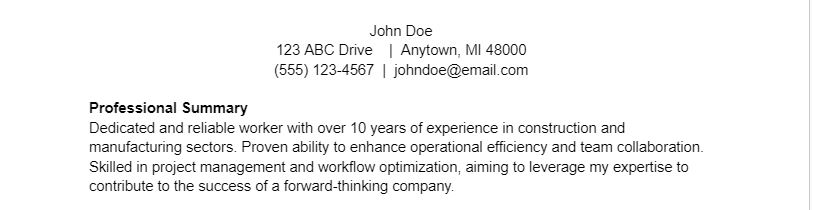
    Begin with your contact information followed by a professional summary. This isn’t the place to dive into your life story. Instead, think of it as an elevator pitch: who you are, what you can do, and how you can contribute to a potential employer. For example, instead of saying, “experienced in construction,” you could say, “Skilled construction worker with 10+ years of experience specializing in renovations and new home construction, known for swiftly mastering new techniques.”

    Highlighting Relevant Experience and Skills
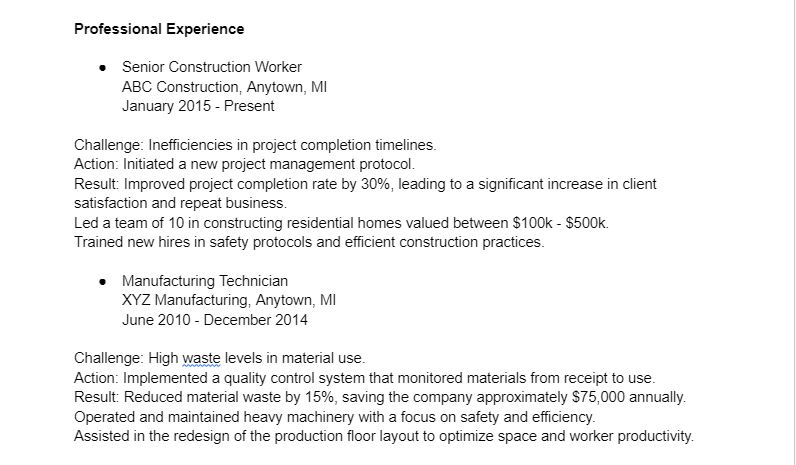
    When listing your experience, focus on the most recent 10 to 15 years, as these are most relevant to employers today. More than just what you did, emphasize how well you did it. For instance, instead of “worked on assembly line,” try “Enhanced assembly line efficiency by 20% through streamlined workflow techniques.”

    Using the CAR Method can help you identify challenges you faced and how you overcame them.

    Quantifying Achievements: The CAR Method
    The CAR (Challenge, Action, Result) format is recommended by experts like Marc Cenedella, founder of Ladders. This approach involves identifying a challenge you faced, the action you took to address it, and the result of your action, preferably quantified. For example:

    Challenge: High waste levels in manufacturing processes.
    Action: Implemented a new quality control system.
    Result: Reduced waste by 15% within six months, saving the company $50,000 annually.

    Education and Continuous Learning

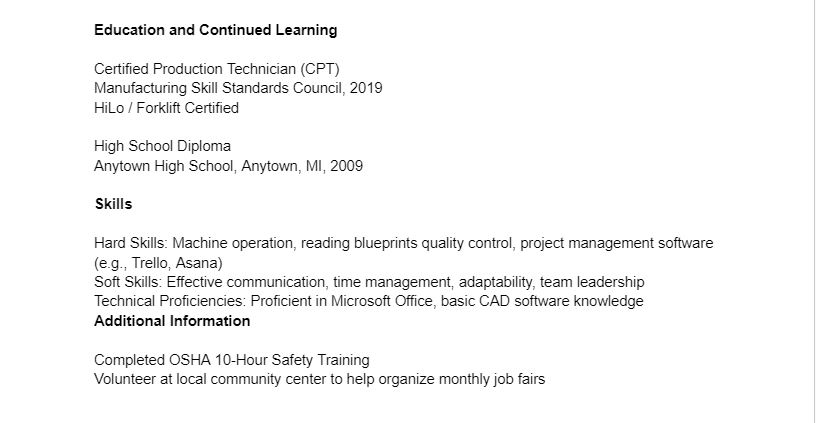
    Even if you haven’t attended formal education recently, any training or certifications can be a big plus. List any relevant courses or certifications under an “Education and Continued Learning” section. This not only shows your commitment to staying current but also enhances your appeal as a candidate who is proactive about personal and professional growth.

    Hard and Soft Skills: Your Hidden Assets
    Hard skills are specific, teachable abilities or skill sets that are easily quantifiable, such as welding or data analysis, whereas soft skills are less tangible and relate to one’s personality traits, such as teamwork and communication. Identifying and listing soft skills can be tricky, especially if you’re not accustomed to categorizing your capabilities. Begin by noting down the tasks you perform regularly, then match these to job listings you’re interested in. This can help you pinpoint which skills to highlight.

    Skills often overlooked, like “time management” from successfully juggling multiple tasks, or “team coordination” from working with groups to complete projects, are incredibly valuable to potential employers. Soft skills can set you apart. These include problem-solving, communication, teamwork, and adaptability—skills often honed through life experiences rather than formal education. Amanda Augustine of TopResume highlights the importance of these skills, noting that they are crucial for adapting to diverse work environments and are often harder to teach than technical skills.

    Customization: Tailor Your Resume

    Every job application should see a customized version of your resume. This means tweaking your resume to include keywords from the job ad and focusing on the skills and experiences that align most closely with the job description. This customization extends to the layout too—keep it simple, use a standard font, and ensure the text is easy to skim.

    Discovering Your Skills

    For those unsure of their skill set, here’s a simple exercise:


    • List Past Jobs: Write down all the jobs you’ve held.
    • Identify Tasks: For each job, list out what you did.
    • Match to Skills: Look at job ads for the roles you want and match your tasks to the skills listed.

    This exercise can help you see how your experiences translate into the skills employers are looking for.

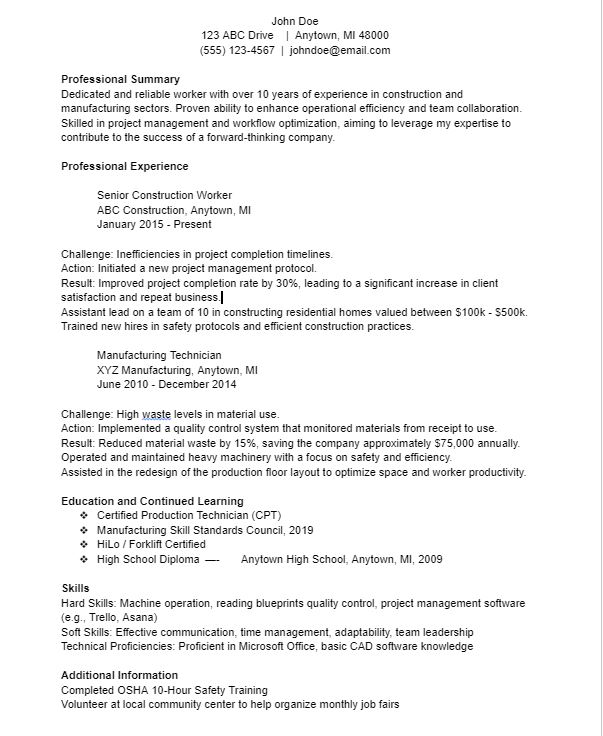
    A single or two-page resume of skills, work history, and education is all you need.

    Parting Thoughts
    Proofread your resume multiple times or have someone else check it for errors—spelling and grammar mistakes can undermine even the strongest content. And remember, while crafting a resume might seem like a chore, it’s a powerful tool in your job search arsenal. With each application, you’re not just detailing past jobs; you’re outlining why you’re the best fit for the future ones.

    Creating a compelling resume can be a game-changer, particularly for those who have traditionally relied on word-of-mouth or informal job markets. By translating your life and work experiences into a format that recruiters can understand, you’re not just looking for any job—you’re opening the door to better opportunities that can lead to financial stability and career satisfaction.