Michigan Economy 2025: The Split No One Wants to Admit

A vertical split-screen image contrasting economic hardship and affluence. Left: A middle-aged couple sits at a dimly lit, cluttered kitchen table covered in bills and receipts, both with worried expressions. Right: A smiling, well-dressed group (one man, two women) walks confidently through a bright, luxurious shopping arcade, carrying designer bags from brands like Chanel and Prada.

The Detroit Regional Chamber’s September 2025 Michigan Statewide Voter Survey, conducted by the Glengariff Group, offers a snapshot of a state both resilient and restless. The data reveal a public that sees signs of economic stabilization but remains haunted by high costs, uneven opportunity, and deep uncertainty about what lies ahead. Over the next six months, the outlook hinges on whether consumer confidence and job quality can overcome the drag of inflation and tariff pressure.

Michigan’s Mood: A Narrow Majority Feels the State is on Track

For the first time since early 2025, more than half of Michigan voters, 51.5 percent, say the state is on the right track, compared to 33.7 percent who believe it is on the wrong one. This modest optimism stems mainly from independents, whose right-track sentiment jumped from 44.7 percent in April to 52.3 percent in September. Strong Republican voters also showed a notable uptick, from 20.9 percent to 34.0 percent. These shifts suggest a fragile coalition of confidence that extends beyond partisan lines, even as economic doubts persist.

But when asked specifically about the economy, Michiganders are divided. Forty-two point four percent say it is on the right track, and 42.8 percent say it is not. This statistical split highlights a state where people may feel better about direction and leadership than about their wallets.

Political identity shapes how people read the same economic facts. This is normal and well documented. Pew shows that views of national economic conditions swing with party control of the White House, with Republicans turning more positive and Democrats more negative in 2025. Gallup reports the same flip in its Economic Confidence Index following the 2024 election, driven by Republicans becoming more upbeat and Democrats more downbeat. Political scientists describe this as motivated reasoning or partisan bias in perception, where people seek and interpret information that affirms prior loyalties rather than updating neutrally. 
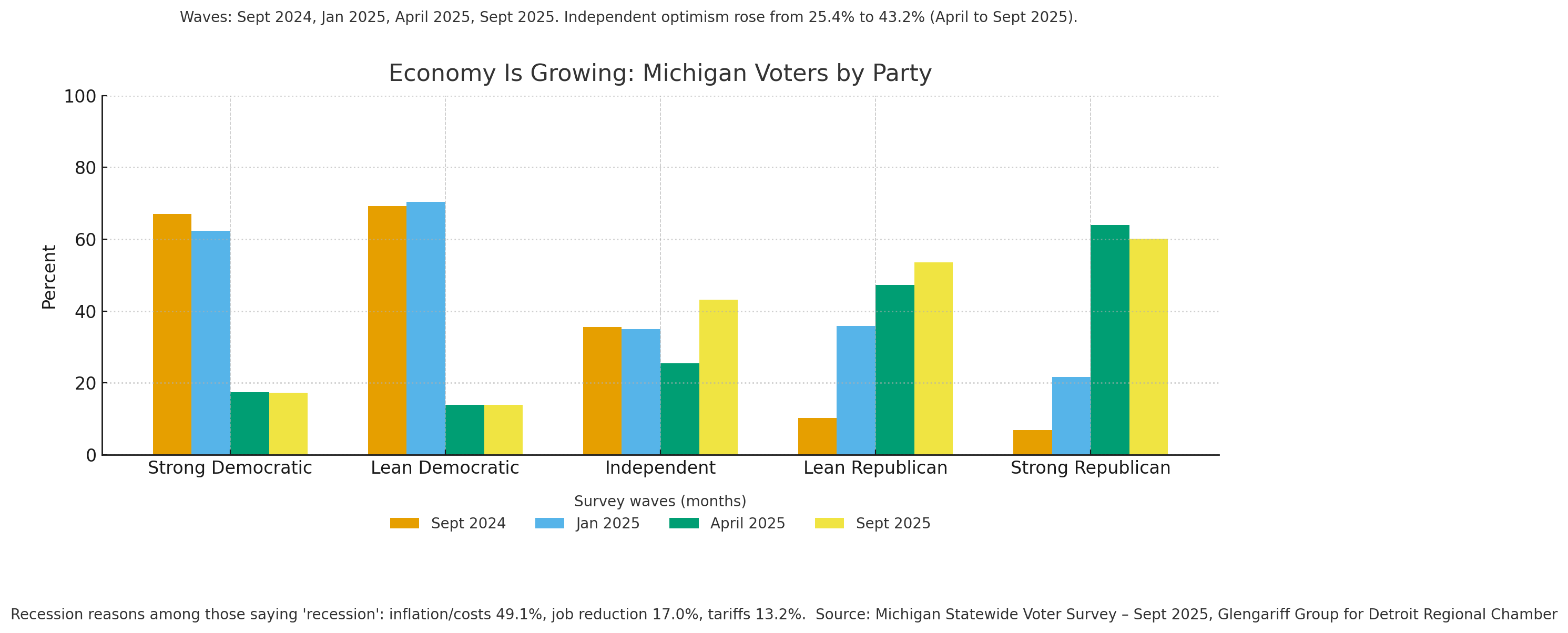
Grouped bar chart titled “Economy Is Growing: Michigan Voters by Party.” X axis lists Strong Democratic, Lean Democratic, Independent, Lean Republican, Strong Republican. Y axis is percent from 0 to 100. Four series labeled Sept 2024, Jan 2025, April 2025, Sept 2025. Strong and Lean Democrats are high in Sept 2024 and Jan 2025 at about 62 to 70 percent, then fall to about 14 to 18 percent by April and Sept 2025. Independents are 35.6 in Sept 2024, 34.9 in Jan 2025, dip to 25.4 in April 2025, then rise to 43.2 in Sept 2025. Lean Republicans rise from 10.2 in Sept 2024 to 53.5 in Sept 2025. Strong Republicans rise from 6.9 in Sept 2024 to 60.2 in Sept 2025. Note shows recession reasons among those saying recession: inflation and costs 49.1 percent, job reduction 17.0 percent, tariffs 13.2 percent. Source Michigan Statewide Voter Survey Sept 2025, Glengariff Group for Detroit Regional Chamber.
Inflation: The Persistent Undercurrent

Inflation remains the state’s defining economic anxiety. Among voters who say Michigan’s economy is on the wrong track, 38.8 percent cite inflation and the cost of goods as the main reason, up sharply from 22.9 percent in May. Three out of four residents, 75.8 percent, report paying more for groceries, two thirds, 68.1 percent, for utilities, and 60.4 percent for home or auto insurance. These figures cut across demographics and party lines.

The pain of rising costs has not translated into universal despair. Roughly 72.6 percent of voters say they are doing better or about the same as a year ago. Yet, of the 27.1 percent who say they are doing worse, a majority, 55.2 percent, blame inflation. Only 16.8 percent say they are doing better, often due to wage increases, promotions, or new jobs, small but meaningful signs of labor-market movement.

Jobs and Hiring: The Confidence Gap

Just over half, 52.0 percent, believe good-paying jobs are available, a drop of eight points since May. That decline is led by Democratic voters, only about one third of whom see strong job prospects. Independents, 60.4 percent, and Republicans, roughly two thirds, are more upbeat. Still, four in ten Michiganders say they know someone looking for work, and 77.8 percent of them say it has been hard to find a job. Among those aware of recent college graduates, 77.0 percent say the same.

This sentiment gap, between perceived availability of good jobs and personal experience finding them, underscores a labor market that feels tight on both sides. For employers, it signals lingering competition for skilled workers even as wage pressure softens. For job seekers, especially younger and lower-income workers, it reflects frustration that openings do not always translate into sustainable pay.

Tariffs: A Clear Economic Flashpoint

Michigan’s manufacturing base feels the bite of global policy more than most. Voters oppose the expanded tariffs by a 51.2 to 40.8 margin. A majority, 71.5 percent, say tariffs have increased what they pay for goods, and 60.3 percent believe tariffs are hurting the state’s auto industry. Nearly half expect smaller profit-sharing checks for auto workers this year.

Those numbers suggest that what was once an abstract policy debate has become a daily reality for Michigan households. The rising costs of vehicles, materials, and inputs are trickling through to local economies. Yet, some blue-collar workers remain more supportive of tariffs than their white-collar counterparts, indicating that the political divide over trade is tied to identity as well as economics.

stack of deliquent bills on a kitchen table with a bag of groceries and a tv out of focus in background
Artificial Intelligence: A Dividing Line Between Opportunity and Anxiety

Nearly half of Michigan voters (47.5%) report using AI in their personal or professional lives, but optimism about its benefits is muted. Only 23.7% believe AI will make Michigan more prosperous, while 39.4% think it will make the state less so. A majority (61.0%) expect AI to lead to fewer jobs, not more Fall-2025-Michigan-Voter-Poll . The divide between white-collar and blue-collar voters is striking: 71.6% of white-collar workers say they use AI, compared to just 36.6% of blue-collar workers. This gap reveals an emerging structural challenge: whether technology adoption will widen or bridge economic divides. If Michigan’s industrial base fails to reskill its workforce at pace with automation, that pessimism could become self-fulfilling.

The Next Six Months: Two Diverging Roads
Optimistic scenario: Inflation continues to cool, tariffs stabilize, and employers—especially in automotive and advanced manufacturing—resume hiring to meet long-term production goals. Wage growth steadies, confidence rises among independents, and consumer spending normalizes into early 2026. Negative scenario: Inflation expectations, already high (43.1% expect it to worsen), drag on real wages. Tariff-driven costs ripple through Michigan’s manufacturing base, curbing output and dampening profit-sharing. Job openings persist, but workers remain mismatched or underpaid. In that climate, optimism could collapse as quickly as it rebounded. The September 2025 survey captures a moment of balance—between endurance and fatigue, adaptation and anxiety. Whether Michigan leans toward renewal or retrenchment will depend less on macroeconomic forces and more on how effectively its employers, educators, and policymakers convert short-term strain into long-term resilience.

Michigan Economy 4Q Outlook 2025: Shutdown Adds New Headwinds

A quiet auto plant shipping dock at midday. Shrink-wrapped pallets with 'HOLD' labels are stacked in rows. A clipboard in the foreground reads 'EPA permit on hold'. Several forklifts are idle near closed dock doors, and a wall clock shows 12:00 noon.

Federal shutdown stalls permits, freezes loans, hits tourism and auto supply chains, eroding confidence across Michigan manufacturers, consumers, and businesses.

Continue reading

The Ripple Effect: How the Dockworkers’ Strike Impacts Michigan Manufacturing

New York City Shipping Port

On October 1, 2024, tens of thousands of dockworkers along the East and Gulf Coasts initiated a historic strike, marking the first such action in nearly five decades. Members of the International Longshoremen’s Association (ILA) walked off the job at 12:01 a.m., effectively shutting down operations at ports from Maine to Texas, including major hubs like the Port Authority of New York and New Jersey.

The strike centers on demands for higher wages and a ban on certain automated equipment that could replace human labor. The dockworkers’ employers, represented by the United States Maritime Alliance (USMX), have been unable to reach an agreement with the union despite last-minute negotiations.

The affected ports account for more than half of the nation’s container imports, handling everything from consumer electronics to raw materials crucial for manufacturing. Key ports impacted include:

  • Port Authority of New York and New Jersey: The third-busiest port in the United States.

  • Port of Savannah, Georgia: A critical gateway for agricultural and manufactured goods.

  • Port of Houston, Texas: A major hub for energy-related products and industrial machinery.

The roots of the strike trace back to longstanding tensions over wages and the introduction of automation in port operations. The ILA argues that while port employers have reaped significant profits—especially during the pandemic-induced trade boom—the wages of dockworkers have not kept pace with inflation.

“They want to make their billion-dollar profits at United States ports, and off the backs of American I.L.A. longshore workers, and take those earnings out of this country,” ILA President Harold Daggett told the New York Times.

Automation has been a particularly contentious issue. The union is pushing back against the implementation of technologies that could reduce the need for human labor, arguing that it threatens job security and the livelihoods of thousands of workers.

What the Sides Are Looking For

  • ILA’s Demands:

    • Wage Increases: The union is seeking a $5-per-hour raise each year over a six-year contract.

    • Job Security: A ban on certain automated equipment to prevent job losses.

    • Better Benefits: Improved pension plans and healthcare benefits.

  • USMX’s Position:

    • Moderate Wage Increases: Offers that the union deems insufficient.

    • Automation Implementation: The alliance wants to modernize port operations to increase efficiency.

As of now, negotiations remain at an impasse. The two sides had barely communicated for months before the strike, and recent talks have failed to bridge the gap. The White House has urged both parties to reach a fair agreement but has stated it will not intervene under the Taft-Hartley Act at this time.

Michigan’s manufacturing sector, a cornerstone of the state’s economy, is particularly vulnerable to the strike’s far-reaching ramifications that extend beyond the coastal states. Relying heavily on a complex web of supply chains that often begin at the now-affected East and Gulf Coast ports, Michigan imports over 40% of its manufacturing inputs from international sources, according to the Michigan Economic Development Corporation. Significant volumes of raw materials and components for key industries such as automotive manufacturing, aerospace, and industrial machinery arrive via these critical entry points. Automotive manufacturers depend on imported components like electronics, transmissions, and specialized steel; the aerospace sector relies on precision parts and materials from international suppliers; and industrial machinery production requires components and raw materials not readily available domestically.

With port operations suspended due to the strike, the flow of goods through these vital channels has effectively come to a halt, leading to a cascade of challenges for Michigan manufacturers. Shipments of raw materials are delayed indefinitely, causing immediate concerns over inventory shortages. Shortages of essential components force manufacturers to reduce or halt production lines, resulting in production slowdowns. Additionally, increased transportation costs become a significant issue as alternatives like air freight or rerouting shipments to West Coast ports are not only significantly more expensive but also more time-consuming. These disruptions collectively pose a serious threat to the stability and productivity of Michigan’s manufacturing industries during the strike.

Timeline of the Strike’s Impact:
Understanding the timeline is crucial for planning and mitigation:
  • Week 1-2: Manufacturers rely on existing inventory and materials in transit.
  • Week 3-4: Inventory levels dwindle. Production schedules are adjusted, and overtime is reduced.
  • Month 2: Severe shortages lead to production halts. Layoffs and furloughs may begin.
  • Beyond Month 2: Long-term contracts are jeopardized. Companies may face financial instability.
Economic Implications for Michigan Manufacturers

A prolonged strike could have dire economic consequences:

  • Revenue Losses: Idle production lines mean lost sales and potential contract penalties.
  • Supply Chain Reconfiguration Costs: Sourcing from new suppliers incurs additional costs and potential quality issues.
  • Investor Confidence: Uncertainty may deter investment in Michigan’s manufacturing sector.
  • Competitive Disadvantages: Global competitors unaffected by the strike may seize market share.
Questions About Automation and Labor Relations

The strike highlights a critical tension between technological advancement and job security—a concern not limited to dockworkers but relevant across all manufacturing sectors.

  • Automation Concerns: The push for automation in ports mirrors similar trends in manufacturing, where robotics and AI are increasingly prevalent.
  • Labor Relations: Proactive engagement with labor unions can prevent disputes and ensure smoother transitions when adopting new technologies.
Strategic Responses for Manufacturers

Manufacturers can take several steps to mitigate the strike’s impact:

  • Assess Inventory Levels: Conduct immediate audits to determine how long operations can continue without resupply.
  • Identify Alternative Suppliers: Explore options not affected by the strike, including domestic suppliers or those accessible via unaffected ports.
  • Communicate with Stakeholders: Keep employees, suppliers, and customers informed about potential impacts and mitigation strategies.
  • Review Contracts: Examine agreements for flexibility in delivery schedules to avoid penalties.
  • Advocate for Resolution: Through industry groups like the Michigan Manufacturers Association, push for a swift resolution.
“When we talk about a two- to three-week strike, that’s when the problem starts to get exponentially worse,” said J. Bruce Chan, a transportation analyst at Stifel, in the New York Times.
Long-Term Considerations

Even after the strike ends, its effects may linger:

  • Supply Chain Resilience: This event underscores the need for diversification and contingency planning.
  • Labor Relations Focus: Investing in positive labor relations can mitigate future disruptions.
  • Technology Adoption: Balancing automation benefits with workforce impacts is essential.
Next Steps:

The dockworkers’ strike along the East and Gulf Coasts presents significant challenges for Michigan’s manufacturing sector. Immediate action and strategic planning are crucial to navigate this complex situation. Manufacturers must assess their vulnerabilities, explore alternatives, and engage proactively with all stakeholders to mitigate risks.

At WSI Recruitment and Staffing, we are committed to providing insights and solutions to help you through these turbulent times. Our expertise in workforce solutions positions us as your partner in overcoming these challenges.

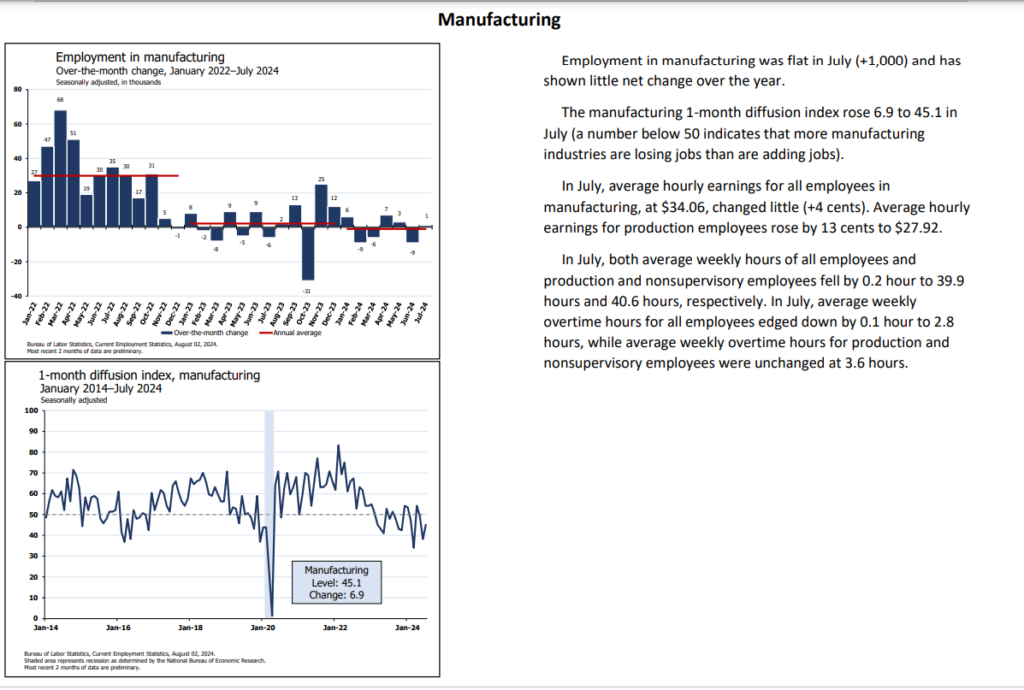
Whiplash Economy: The Impact on Manufacturing Jobs

If 2024 has taught us anything, it’s that the economy is like a rollercoaster you never quite signed up for. Earlier this month, we had a less-than-stellar jobs report—cue the collective sigh of disappointment. The U.S. economy added fewer jobs than expected, falling short of projections and rattling market confidence. For a moment, it felt like the rug was being pulled out from under us again, especially for the manufacturing sector, which has been caught in a downward spiral for most of the year.

Early August Panic and Sudden Recovery
In the days following the jobs report, the market had a brief but intense panic attack, reminiscent of the wild whipsaw reactions we’ve become accustomed to in recent years. The Dow took a dive, dragging spirits down with it. Analysts began sounding the alarm, predicting that the economy was losing steam faster than anticipated. Manufacturing, already battered by supply chain woes and fluctuating costs, braced for another blow as hiring seemed destined for the slow lane.

But just as we were buckling up for more turbulence, the narrative flipped. Inflation data started showing a much-needed cool-down, and suddenly, the Fed’s iron-fisted grip on interest rates seemed ready to loosen. The markets, always fickle, reversed course, with stocks rebounding almost as quickly as they had fallen. The prospect of a Fed rate cut in September emerged, injecting a dose of optimism into an economy that had seemed on the brink just days earlier.

The Tug-of-War on Manufacturing Jobs
For the manufacturing sector, these back-and-forth waves have been particularly jarring. On one hand, the disappointing jobs report raised fears of continued layoffs and a tightening labor market. On the other, the improving economic indicators like cooling inflation and strong retail performance from giants like Walmart offer a glimmer of hope. Could this finally be the turn manufacturing has been waiting for?

There’s a case to be made for cautious optimism. If the Fed does cut rates in September, manufacturers could see lower borrowing costs, which might prompt some to invest in growth and, by extension, jobs. Stable input costs, driven by cooling inflation, would also provide much-needed relief. But let’s not break out the champagne just yet. The sector is still licking its wounds from earlier in the year, and hiring might remain conservative until there’s more certainty that this recovery isn’t just another false dawn.

Navigating the Mixed Signals
The economy’s current state is like a rickety bridge, wobbling under the weight of mixed signals. For every piece of good news, like the potential for a Fed rate cut, there’s a reminder of the fragility that still exists, such as the weak jobs report. Manufacturing, as always, is caught in the middle. The sector’s recovery will likely be slow and uneven, with businesses cautious about adding to their workforce until they see sustained signs of stability.

In the meantime, manufacturing workers and employers alike will need to stay agile, navigating these unpredictable waters with a mix of hope and pragmatism. The economy may be sending out mixed signals, but one thing is clear: the ride is far from over.