Can a President Really Grow Manufacturing?

clean energy symbols like electric cars and windmills on the blue side under the donkey, and a pickup truck with oil rigs on the red side under the elephant. This should further highlight the contrast in political ideologies, while keeping the manufacturing center unaffected by the chaos.

As the upcoming election draws near, the revitalization of American manufacturing has once again become a central theme in political discourse. Presidential candidates are making ambitious promises to bring back factory jobs and strengthen the industry. However, for manufacturing professionals in Michigan—a state with a rich industrial heritage—the pressing question is: How much can a president truly influence the revival of manufacturing, and what local opportunities are shaping the industry’s future? This recent New York Times article asked that question. In this blog, we examine how the election could affect jobs here in Michigan. 

Political Proposals vs. Economic Realities

Former President Donald J. Trump proposes imposing hefty tariffs on nearly all imports to encourage foreign companies to produce goods in the United States. Vice President Kamala Harris, meanwhile, advocates for tax credits and expanded apprenticeships to bolster factory towns and invest in advanced technologies. While these proposals make for compelling campaign narratives, historical evidence suggests that no president can single-handedly dictate the growth of specific industries.

Economic forces such as global market trends, technological advancements, and exchange rates often have a more significant impact on manufacturing. While federal policies can provide incentives and create a favorable environment, the real drivers of manufacturing growth are often found at the state and local levels.

Sun Belt States: The Rise of Business-Friendly Environments

In recent years, manufacturing jobs have been migrating toward the Sun Belt states—such as Texas, Florida, and those in the Southeast—known for their business-friendly climates. These states offer lower taxes, fewer regulations, reliable access to power, and a growing workforce attracted by a lower cost of living and favorable weather.

Nevada, for example, has seen its manufacturing job base grow by more than 13% from early 2020 to March 2023. The state has actively worked to diversify its economy beyond hospitality and entertainment, offering incentives and a welcoming atmosphere for manufacturers. Companies like Alliance North America (ANA) have relocated there, attracted by lower operational costs and a supportive business environment.

“Instead of companies choosing the right location based on all of their other requirements and the presumption that the workers are going to come to them, companies are starting from the presumption of, where are the people moving to?” said Didi Caldwell, president and CEO of Global Location Strategies.

Michigan’s Manufacturing Landscape: Leveraging Local Opportunities

Michigan offers a variety of subsidies and incentives designed to lure businesses and encourage expansion:

  • Michigan Business Development Program (MBDP): Provides grants, loans, and other economic assistance to businesses that create qualified new jobs and make new investments in Michigan.

  • Industrial Property Tax Abatement (PA 198): Offers property tax incentives to manufacturers looking to renovate or expand facilities, reducing costs associated with property improvements.

  • Michigan New Jobs Training Program (MNJTP): Assists employers in training workers for new positions by providing flexible funding to meet the demand for skilled labor.

  • Michigan Reconnect Program: Aims to help adults over the age of 25 earn a tuition-free associate degree or skilled trade certificate. This program enhances the workforce by providing manufacturers with a pool of skilled workers trained in advanced manufacturing techniques.

  • Good Jobs for Michigan Program: Provides incentives for businesses that create a significant number of high-paying jobs, aiming to boost the state’s economy and employment rates.

These programs underscore Michigan’s commitment to fostering a business-friendly environment, reducing operational costs, and supporting workforce development—a critical factor for manufacturers considering relocation or expansion.

Candidates Kamala Harris and Donald Trump have different ideas how to grow manufacturing in the USA.

Case Study: Michigan’s Attractiveness to Manufacturers

Several companies have taken advantage of Michigan’s incentives to grow their operations:

Ford Motor Company’s Electric Vehicle Investment: Ford has announced significant investments in Michigan to expand electric vehicle production, leveraging state incentives to modernize facilities and retrain workers.

LG Energy Solution’s Battery Plant Expansion: In Holland, Michigan, LG Energy Solution is expanding its battery manufacturing plant, supported by state grants and tax incentives aimed at boosting the clean energy sector.

These developments highlight Michigan’s strategic focus on not only preserving its manufacturing legacy but also pivoting towards emerging industries like electric vehicles and renewable energy technologies.

Balancing Local Advantages with National Trends

While the Sun Belt states offer attractive environments for manufacturers, Michigan’s unique combination of incentives, skilled workforce, and infrastructure continues to make it a compelling choice for manufacturing professionals.

Manufacturers in Michigan benefit from:

Skilled Workforce: Michigan boasts a rich pool of skilled labor, thanks to its strong educational institutions and programs like the Michigan Reconnect, which enhances workforce skills by providing tuition-free pathways for adults seeking degrees or certificates in high-demand fields.

Infrastructure and Logistics: The state’s robust transportation network—including major highways, railroads, and ports—facilitates efficient distribution and supply chain operations.

Community and Government Support: Local governments often work closely with businesses to streamline permitting processes and provide assistance, enhancing the ease of doing business.

Cautious Optimism Amid Uncertainty

Despite the positive local factors, the manufacturing industry remains cautious due to broader economic uncertainties and the impending election. Companies are mindful that the outcome could influence taxes, trade policies, and regulations.

“We’re a couple of months away from a huge decision point—who controls Congress and the White House,” said Timothy Fiore, manufacturing business committee chair at the Institute for Supply Management. “I think we’re kind of stuck here until the end of the year.”

Seizing Opportunities in Michigan While Recognizing National Trends

For manufacturing professionals in Michigan, the path to revitalization lies in leveraging state-specific incentives and opportunities while staying aware of national trends like the growth in Sun Belt states. While federal policies and political promises can influence the broader landscape, it’s the tangible, local actions that create a conducive environment for growth.

Michigan’s commitment to supporting manufacturing through various incentives, workforce development programs like Michigan Reconnect, and a business-friendly climate positions it as fertile ground for industry expansion. As the election nears, industry stakeholders should focus on these local advantages, ensuring they are well-positioned to capitalize on the opportunities ahead, regardless of political outcomes.

Crafting Your Future: The Ultimate Resume Guide for Blue-Collar Workers

picture of a resume on a clipboard being viewed by point of view. male with hands folded on table in blue shirt is softly focused in the background

At WSI, we do not require resume to apply for our client’s openings. But, in today’s competitive job market, having a polished resume is crucial—even for those who’ve never needed one before. This includes many blue-collar workers in manufacturing and service workers, who might find the idea of crafting a resume daunting or even unnecessary. But here’s the thing: A well-crafted resume can open doors to better job opportunities and financial stability, even for those traditionally in lower-income brackets.

Understanding the Modern Resume
A resume today isn’t just a list of past jobs—it’s a marketing tool designed to showcase your skills and achievements. According to Eric Ciechanowski, a career expert at LiveCareer, resumes have evolved significantly over the past five years, not just in length but in substance too. Gone are the days of the one-page resume; now, a two-page format that highlights a blend of hard and soft skills, certifications, and quantifiable achievements is the norm.

Starting Strong: Contact and Summary

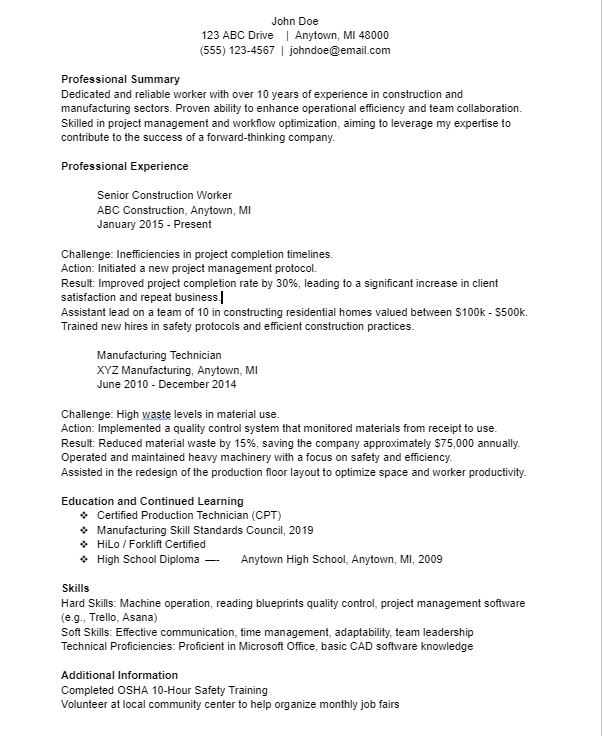
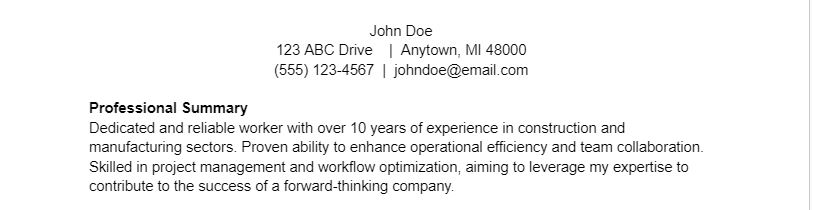
Begin with your contact information followed by a professional summary. This isn’t the place to dive into your life story. Instead, think of it as an elevator pitch: who you are, what you can do, and how you can contribute to a potential employer. For example, instead of saying, “experienced in construction,” you could say, “Skilled construction worker with 10+ years of experience specializing in renovations and new home construction, known for swiftly mastering new techniques.”

Highlighting Relevant Experience and Skills
When listing your experience, focus on the most recent 10 to 15 years, as these are most relevant to employers today. More than just what you did, emphasize how well you did it. For instance, instead of “worked on assembly line,” try “Enhanced assembly line efficiency by 20% through streamlined workflow techniques.”

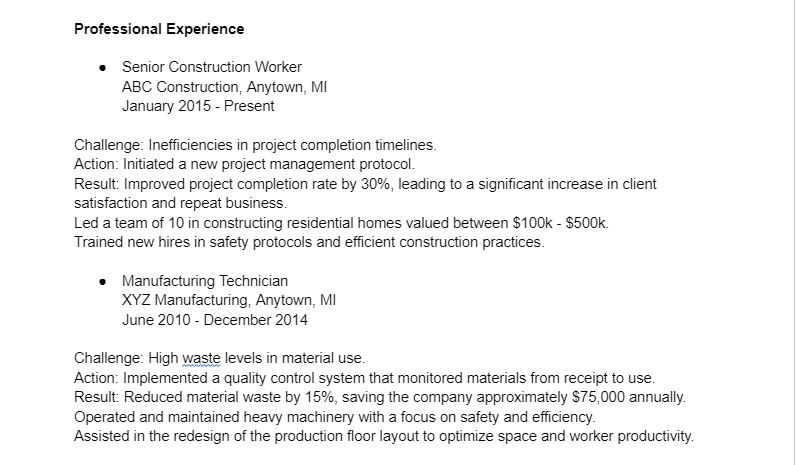
Using the CAR Method can help you identify challenges you faced and how you overcame them.

Quantifying Achievements: The CAR Method
The CAR (Challenge, Action, Result) format is recommended by experts like Marc Cenedella, founder of Ladders. This approach involves identifying a challenge you faced, the action you took to address it, and the result of your action, preferably quantified. For example:

Challenge: High waste levels in manufacturing processes.
Action: Implemented a new quality control system.
Result: Reduced waste by 15% within six months, saving the company $50,000 annually.

Education and Continuous Learning

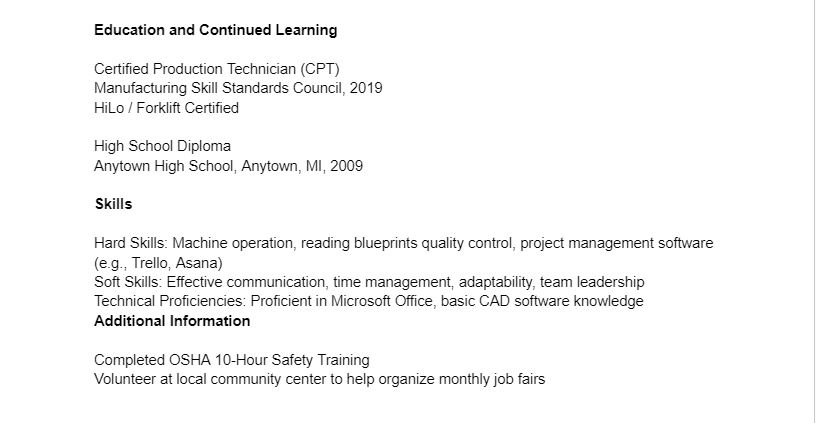
Even if you haven’t attended formal education recently, any training or certifications can be a big plus. List any relevant courses or certifications under an “Education and Continued Learning” section. This not only shows your commitment to staying current but also enhances your appeal as a candidate who is proactive about personal and professional growth.

Hard and Soft Skills: Your Hidden Assets
Hard skills are specific, teachable abilities or skill sets that are easily quantifiable, such as welding or data analysis, whereas soft skills are less tangible and relate to one’s personality traits, such as teamwork and communication. Identifying and listing soft skills can be tricky, especially if you’re not accustomed to categorizing your capabilities. Begin by noting down the tasks you perform regularly, then match these to job listings you’re interested in. This can help you pinpoint which skills to highlight.

Skills often overlooked, like “time management” from successfully juggling multiple tasks, or “team coordination” from working with groups to complete projects, are incredibly valuable to potential employers. Soft skills can set you apart. These include problem-solving, communication, teamwork, and adaptability—skills often honed through life experiences rather than formal education. Amanda Augustine of TopResume highlights the importance of these skills, noting that they are crucial for adapting to diverse work environments and are often harder to teach than technical skills.

Customization: Tailor Your Resume

Every job application should see a customized version of your resume. This means tweaking your resume to include keywords from the job ad and focusing on the skills and experiences that align most closely with the job description. This customization extends to the layout too—keep it simple, use a standard font, and ensure the text is easy to skim.

Discovering Your Skills

For those unsure of their skill set, here’s a simple exercise:


  • List Past Jobs: Write down all the jobs you’ve held.
  • Identify Tasks: For each job, list out what you did.
  • Match to Skills: Look at job ads for the roles you want and match your tasks to the skills listed.

This exercise can help you see how your experiences translate into the skills employers are looking for.

A single or two-page resume of skills, work history, and education is all you need.

Parting Thoughts
Proofread your resume multiple times or have someone else check it for errors—spelling and grammar mistakes can undermine even the strongest content. And remember, while crafting a resume might seem like a chore, it’s a powerful tool in your job search arsenal. With each application, you’re not just detailing past jobs; you’re outlining why you’re the best fit for the future ones.

Creating a compelling resume can be a game-changer, particularly for those who have traditionally relied on word-of-mouth or informal job markets. By translating your life and work experiences into a format that recruiters can understand, you’re not just looking for any job—you’re opening the door to better opportunities that can lead to financial stability and career satisfaction.

Why is American Manufacturing Surging? Unpacking the 2024 Boom

a microchip in the center of the action with an american flag imprinted on it. factories dot the landscape with light beams pointing inward

Discover how U.S. manufacturing’s surprising growth is shaping the future, driving innovation, and setting global economic trends.

Continue reading

You’re Doing Great! New Report Says Worker Confidence Is Soaring.

three workers in factory gear give a thumbs up in approval

As 2023 wrapped up, American workers started feeling a lot more hopeful about their jobs, marking a big change after a tough year. The latest U.S. Worker Confidence Index (WCI) for the last quarter shows that workers are feeling better than ever, giving us all a reason to be optimistic as we step into Q2 of 2024. Today, we look into why workers are feeling more confident and what it might mean for jobs and the economy moving forward.

The start of 2023 was shaky for many workers across the U.S., with worries about the economy, job security, and other global issues. But by the end of the year, things took a positive turn, and the WCI hit an all-time high. This isn’t just a random good news story—it shows that the economy is getting stronger and the job market is bouncing back.

The WCI measures how workers feel in four key areas: job security, chances of getting a raise, chances of getting promoted, and how much they trust their company’s leaders. The score shot up to 114.9 points, which is really impressive, especially after it was dropping for most of 2023. Workers are now more optimistic about moving up in their careers and believing in their company’s leadership than they’ve been in a while.

Even with the overall positive vibe, not everyone is feeling secure about their jobs. The Job Security Index dipped a little, showing that while some people are feeling more secure, others, especially men and workers in their prime years, are not as confident. This mix of feelings shows that there’s still some work to do to make everyone feel stable in their jobs.

A big highlight from the last quarter is that workers are really optimistic about getting promoted and getting raises. The scores for these areas jumped up a lot, turning around the downward trend from before. This means that more people believe they’ll move up in their careers and get recognized with better pay.

Trust in company leaders also went up, which is great news. When workers believe in their leaders, it makes for a better work environment, especially during uncertain times. Nearly half of the workers now feel good about their company’s leadership, which is a big step forward.

three men in a factory wearing factory gear all stand shoulder to shoulder in approval of their jobs. They seem happy.

The Bigger Economic Picture

The rise in worker confidence comes at a time when the U.S. job market is doing well, and the economy is picking up. The last quarter saw a lot of new jobs, especially in healthcare, hospitality, and government. Despite challenges like higher interest rates and inflation, the strong job market and growing consumer confidence show that the economy is on the right path.

Looking ahead to 2024, there’s a cautious but real sense of optimism. The economy and job market are expected to keep getting stronger, though the pace might slow down a bit. It’s important for companies to keep listening to their workers, especially when it comes to job security and career growth.

Why Worker Confidence Matters

The insights from the WCI are not just numbers; they show us how American workers are feeling overall. High confidence can lead to better work, more creativity, and stronger loyalty to companies. On the flip side, when workers aren’t feeling great, it can hurt productivity and morale. That’s why it’s crucial for companies to keep an eye on how their employees are feeling.

The last quarter of 2023 showed us that despite challenges, American workers are feeling hopeful and confident about the future. This is great news for everyone. For businesses, it’s a reminder of how important it is to create a positive work environment where employees feel valued and supported. Moving into 2024, we’ll all benefit from keeping the momentum going and making sure workers continue to feel confident and satisfied with their jobs.

Skills Over Degrees: How Michigan is Shaping the Future Workforce

In Michigan, 54% of jobs demand specialized training or certifications. This Career & Technical Education Month, let’s explore the rich opportunities that lie beyond the traditional four-year degree.

Continue reading

Right To Work Falls In Michigan: The First Domino?

The repeal of Michigan’s “right-to-work” law this month marks a significant shift in the state’s labor landscape, representing a major victory for organized labor in a state historically known as a bastion of union activity. This move comes after Democrats regained control of the state government, enabling them to pursue a range of legislative priorities that had been obstructed by the previous Republican majority. The “right-to-work” law, enacted in 2012, allowed workers in unionized workplaces to opt out of paying union dues, a provision criticized by unions for creating “free riders” who benefited from union representation without contributing financially. Its repeal is expected to strengthen unions by requiring all workers in unionized settings to pay dues, thereby enhancing unions’ bargaining power and financial resources.

Right-to-work” laws are state statutes that prohibit agreements between labor unions and employers that make membership or payment of union dues or fees a condition of employment, either before or after hiring. Essentially, these laws allow individuals to work in unionized workplaces without being required to join the union or pay union dues. Proponents of “right-to-work” laws argue that they protect workers’ freedom of association and provide them with a choice about whether to support a union financially. However, critics contend that these laws weaken unions by allowing some employees to benefit from union negotiations and protections without contributing to the costs of union representation, creating a “free-rider” problem. This can lead to reduced funding and bargaining power for unions, potentially impacting their ability to negotiate better wages, benefits, and working conditions for their members. The debate over “right-to-work” laws is deeply intertwined with broader discussions about the role of unions in the workforce, workers’ rights, and the economic impacts of union membership on wages and job growth.

The broader implications of this legislative change extend beyond the immediate financial boost to unions. By restoring the prevailing wage law alongside the “right-to-work” repeal, Michigan signals a commitment to elevating labor standards and ensuring that workers on state projects receive union-level compensation. This aligns with the Democratic leadership’s goals of protecting workers, fostering a strong middle class, and making Michigan an attractive destination for labor.

However, the repeal has sparked concerns among opponents, who argue that it could deter businesses from investing in Michigan, fearing that the state’s labor market may become less competitive due to the perceived increase in labor costs and the potential for forced union membership. This perspective reflects a broader debate over the impact of “right-to-work” laws on economic growth and job creation, with critics pointing to the potential for such policies to contribute to lower wages and weaker labor rights.

The historical context is crucial for understanding the significance of this move. Michigan becomes the first state in nearly six decades to repeal a “right-to-work” law, reversing a trend that saw such laws proliferate across the United States, particularly in the Midwest. The state’s action could inspire similar efforts in other states where Democrats gain legislative control, signaling a potential shift in the national conversation around labor rights and union power.

The controversy surrounding the “right-to-work” law and its repeal underscores the deeply polarized nature of American politics, especially on issues related to labor and economic policy. The inclusion of appropriations in the legislation, effectively making it referendum-proof, highlights the strategic maneuvers both parties employ to advance their agendas and secure legislative achievements against future political reversals.

Looking ahead, the repeal’s long-term effects on Michigan’s economy, labor market, and political landscape remain to be seen. While it undoubtedly strengthens organized labor and aligns with the Democratic Party’s pro-worker stance, the broader economic implications and the response from the business community will play a critical role in shaping Michigan’s future. As other states observe Michigan’s experience, the debate over “right-to-work” laws and their impact on workers, unions, and economies will likely continue to evolve, reflecting the ongoing struggle to balance economic competitiveness with labor rights and protections.

12 High Paying Jobs for 2024 – No Degree Required!

The labor market in 2024 is set to see a significant demand for skilled trade jobs, a vital sector in the US economy. These jobs offer lucrative pay, engaging work environments, and are essential in various industries. Here’s a list of 12 high-demand, high-paying trade jobs:

1. Ultrasonographer ($131,161/year): With a 10% job growth rate, they perform diagnostic medical imaging.

2. Respiratory Therapist ($104,437/year): Essential in healthcare with a 13% growth rate, they assist patients with breathing issues.

3.  Dental Hygienist ($99,013/year): A 7% growth rate job focusing on oral health.

4.  Construction Manager ($88,319/year): With a 5% growth rate, they oversee construction projects.

5.  Aircraft Mechanic ($82,476/year): Ensuring aircraft safety, with a 4% job growth.

6.  Cable Technician ($70,714/year): A 6% growth rate in this tech-based role.

7.  Industrial Mechanic ($69,637/year): They maintain and repair industrial machinery, with a 13% growth rate.

8.  Solar Installer ($69,422/year): A rapidly growing field at 22%, focusing on renewable energy.

9.  Real Estate Appraiser ($64,075/year): Valuing properties with a 5% growth rate.

10. Electrician ($62,739/year): Essential for electrical systems with a 6% growth rate.

11.  Licensed Practical Nurse ($59,125/year): A vital healthcare role, growing at 5%.

12.  Wind Turbine Technician ($58,005/year): A booming field with a 45% growth rate, focusing on sustainable energy.

a male hand holds a pipe wrench up into the sky

These trades, requiring varying levels of vocational training or specialized schooling, are not just financially rewarding but are crucial for the economy’s health. Their roles are more than just jobs; they’re careers that shape the very infrastructure and well-being of society. As technology and industries evolve, these trades are at the forefront, ensuring efficiency, safety, and innovation. Emphasizing these trades’ importance and encouraging more people to enter these fields is essential to bridge the impending trade gap in the US labor force.

The evolving job market is increasingly valuing trades and associate degrees, marking a shift in what constitutes the ‘smart kids’ club. A 2023 survey by Intelligent.com reveals that nearly half of US companies plan to eliminate bachelor’s degree requirements in 2024, a trend that started in 2023. This change is driven by a desire to create more diverse workforces and the recognition that experience often outweighs formal education. Employers are now focusing on practical skills, with 80% prioritizing experience over education. Additionally, alternative educational paths like certificate programs and apprenticeships are gaining value, reflecting a broader understanding of skill acquisition beyond traditional four-year degrees. This trend underscores the growing importance of practical, hands-on skills in the modern labor market.

The Michigan Apprenticeship Program is a dynamic pathway combining practical working experience with learning, beneficial for both employers and apprentices. It’s a no-cost service provided by the State of Michigan, designed to simplify the process of registered apprenticeship. The program aims to build a skilled workforce by connecting Michigan employers with job seekers, offering crucial support and resources to both parties.

Registered Apprenticeship in Michigan, supported by the Department of Labor/Office of Apprenticeship, allows employers to create customized skilled trades training programs. This is particularly important in industries experiencing a significant gap between job openings and skilled workers. The program is recognized as a valuable training model by the Michigan Department of Labor and Economic Opportunity. It involves on-the-job training and classroom instruction under the supervision of experienced industry professionals, serving as mentors. This approach not only benefits workers by providing job-related, classroom-based learning with paid on-the-job training in high-skill, high-wage, in-demand industry occupations, but it also helps employers by creating a pipeline of professional workers through work-based learning.

The program includes seven core components: Industry Led, Paid Job, Structured On-the-Job Learning/Mentorship, Supplemental Education, Diversity, Quality & Safety, and Credential. Each Registered Apprenticeship program is customized to meet specific employer needs, and upon completion, participants receive a nationally-recognized industry credential.

This approach is proving to be an effective strategy for recruiting, training, and retaining employees, perfect for filling the talent pipeline with highly skilled, diverse, and productive workers. It demonstrates the state’s commitment to developing a skilled workforce that meets the needs of today’s and tomorrow’s industries.

Meet Four Battle Creek Employers Who Are Training Tomorrow’s Workforce

apprentice learnings from teacher wearing yellow vest

Four Battle Creek employers were celebrated for pioneering in Registered Apprenticeship Programs. Recognized at Kellogg Community College, these firms exemplify effective workforce training, aligning with Michigan’s strategy to bolster the local talent pipeline and support skilled labor development. This initiative is part of a broader effort to upskill Michigan’s workforce.

Continue reading

Six Tips to Complete Your High School Diploma

GLOBE AND graduation cap on top of books .How to lose $770 a year.

Embark on a journey of success with your high school diploma—a key that unlocks a multitude of opportunities. Dive into our latest blog to gain insightful tips on completing your education and propelling your career forward, no matter where you are

Continue reading